A Complete Introduction to Combinatorics
From Fundamentals to Applications
Target Audience: Mathematics students, engineers, and self-learners.
Prerequisites: Basic algebra.
Introduction
Welcome to the fascinating world of combinatorics! This document will guide you from having no prior knowledge of combinatorics to developing a comprehensive understanding of its principles, methods, and applications.
What is Combinatorics?
Combinatorics is the branch of mathematics concerned with counting, arranging, and selecting objects[1]. At its core, combinatorics answers questions like: "How many ways can we arrange these items?" or "How many ways can we choose a subset from a larger set?" While these might seem like simple questions, they form the foundation of complex problem-solving across computer science, probability theory, statistics, optimization, and even cryptography[2].
The word "combinatorics" comes from the mathematical concept of combinations, and the field encompasses five major branches: enumeration (counting), graph theory (networks and connections), Ramsey theory (patterns in structures), design theory (optimal arrangements), and coding theory (information transmission)[3].
Why Study Combinatorics?
Combinatorics is not just theoretical mathematics—it has profound real-world applications:
- Computer Science: Algorithm design, data structure optimization, and computational complexity analysis
- Network Design: Routing algorithms for the Internet and telecommunications networks
- Cryptography: Encryption methods and network security protocols
- Business: Scheduling problems, resource allocation, and operational optimization
- Biology: DNA sequencing, molecular structure analysis, and genetic combinations
- Social Sciences: Social network analysis and modeling human interactions
Understanding combinatorics equips you with powerful problem-solving tools applicable across numerous disciplines[4][5].
Part 1: Fundamental Counting Principles
The Rule of Sum (Addition Principle)
Principle: If one event can occur in $m$ ways and a separate, mutually exclusive event can occur in $n$ ways, then the total number of ways either event can occur is $m + n$ ways[6].
Key Point: The events cannot happen simultaneously. It's an "either/or" situation.
Example: Suppose you want to travel from City A to City C. You can either:
- Take a direct flight (3 available flights), OR
- Take a train (5 available trains)
Since you must choose one method of travel, the total number of ways to travel from A to C is $3 + 5 = 8$ ways.
When to Use: Use the addition principle when you have alternatives or choices between different options that cannot occur together.
The Rule of Product (Multiplication Principle)
Principle: If one event can occur in $m$ ways and, after it occurs, a second independent event can occur in $n$ ways, then the two events together can occur in $m \times n$ ways[6][7].
Key Point: Both events happen in sequence. It's an "and then" situation.
Example: Consider traveling from City A to City C via City B. There are:
- 3 roads from A to B, AND
- 5 roads from B to C
The total number of different routes from A to C (going through B) is $3 \times 5 = 15$ ways.
Another Example: If you have 4 shirts and 3 pairs of pants, you can create $4 \times 3 = 12$ different outfits.
When to Use: Use the multiplication principle when events occur in sequence and you need to count all possible combinations of outcomes.
Practice Problem Set 1
Try these problems to test your understanding:
- A restaurant offers 5 appetizers, 8 main courses, and 4 desserts. How many different three-course meals can you create?
- You can travel from home to work by car (4 routes) or by bus (6 routes). How many travel options do you have?
- A password consists of 3 letters followed by 2 digits. How many possible passwords exist? (Assume 26 letters and 10 digits)
Solutions:
- Using multiplication principle: $5 \times 8 \times 4 = 160$ different meals
- Using addition principle: $4 + 6 = 10$ travel options
- Using multiplication principle: $26 \times 26 \times 26 \times 10 \times 10 = 1{,}757{,}600$ passwords
Part 2: Permutations – Counting Arrangements
What is a Permutation?
A permutation is an arrangement of objects where order matters[8]. When we permute items, we're counting all the different ways to arrange them in sequence.
Fundamental Question: "In how many ways can we arrange $n$ distinct objects?"
Permutations of n Objects
If we have $n$ distinct objects and want to arrange all of them, the number of permutations is:
The symbol $n!$ is read as "n factorial."
Example: How many ways can you arrange 5 books on a shelf?
Intuition: For the first position, you have 5 choices. After placing one book, you have 4 remaining choices for the second position, then 3 for the third, and so on.
Permutations of k Objects from n Objects
Sometimes we want to arrange only $k$ objects selected from a larger set of $n$ objects (where $k \leq n$). This is denoted as $P(n,k)$ or $^nP_k$:
Example: In a race with 10 runners, how many different ways can the gold, silver, and bronze medals be awarded?
Intuition: We have 10 choices for gold, then 9 remaining choices for silver, then 8 remaining choices for bronze.
Permutations with Repetition
When objects are not all distinct, we must account for repetitions. If we have $n$ objects where some are identical, the number of distinct permutations is:
where $n_1, n_2, \ldots, n_k$ are the counts of each type of identical object.
Example: How many distinct arrangements exist for the letters in "MISSISSIPPI"?
The word has 11 letters: 1 M, 4 I's, 4 S's, and 2 P's.
Practice Problem Set 2
- How many ways can 7 people line up for a photograph?
- From a class of 20 students, how many ways can a president, vice-president, and secretary be chosen?
- How many distinct arrangements are there for the letters in "BANANA"?
Solutions:
- $7! = 5{,}040$ ways
- $P(20,3) = 20 \times 19 \times 18 = 6{,}840$ ways
- 6 letters (3 A's, 2 N's, 1 B): $\frac{6!}{3! \times 2! \times 1!} = \frac{720}{6 \times 2 \times 1} = 60$ arrangements
Part 3: Combinations – Counting Selections
What is a Combination?
A combination is a selection of objects where order does not matter[8]. When we form combinations, we're only interested in which objects are chosen, not the sequence in which they appear.
Fundamental Question: "In how many ways can we choose $k$ objects from $n$ objects?"
The Combination Formula
The number of ways to choose $k$ objects from $n$ objects (where $k \leq n$) is denoted as $C(n,k)$ or $\binom{n}{k}$ (read as "n choose k"):
This number is called the binomial coefficient.
Example: A lottery requires selecting 5 numbers from 90 possible numbers. How many different lottery tickets exist?
Why Does This Formula Work?
The logic behind the combination formula is elegant:
- If order mattered, we'd have $P(n,k) = \frac{n!}{(n-k)!}$ arrangements
- But since order doesn't matter, we've overcounted by a factor of $k!$ (the number of ways to arrange $k$ objects)
- Therefore: $C(n,k) = \frac{P(n,k)}{k!} = \frac{n!}{k! \times (n-k)!}$
Visualizing Combinations: The 5 Choose 3 Example
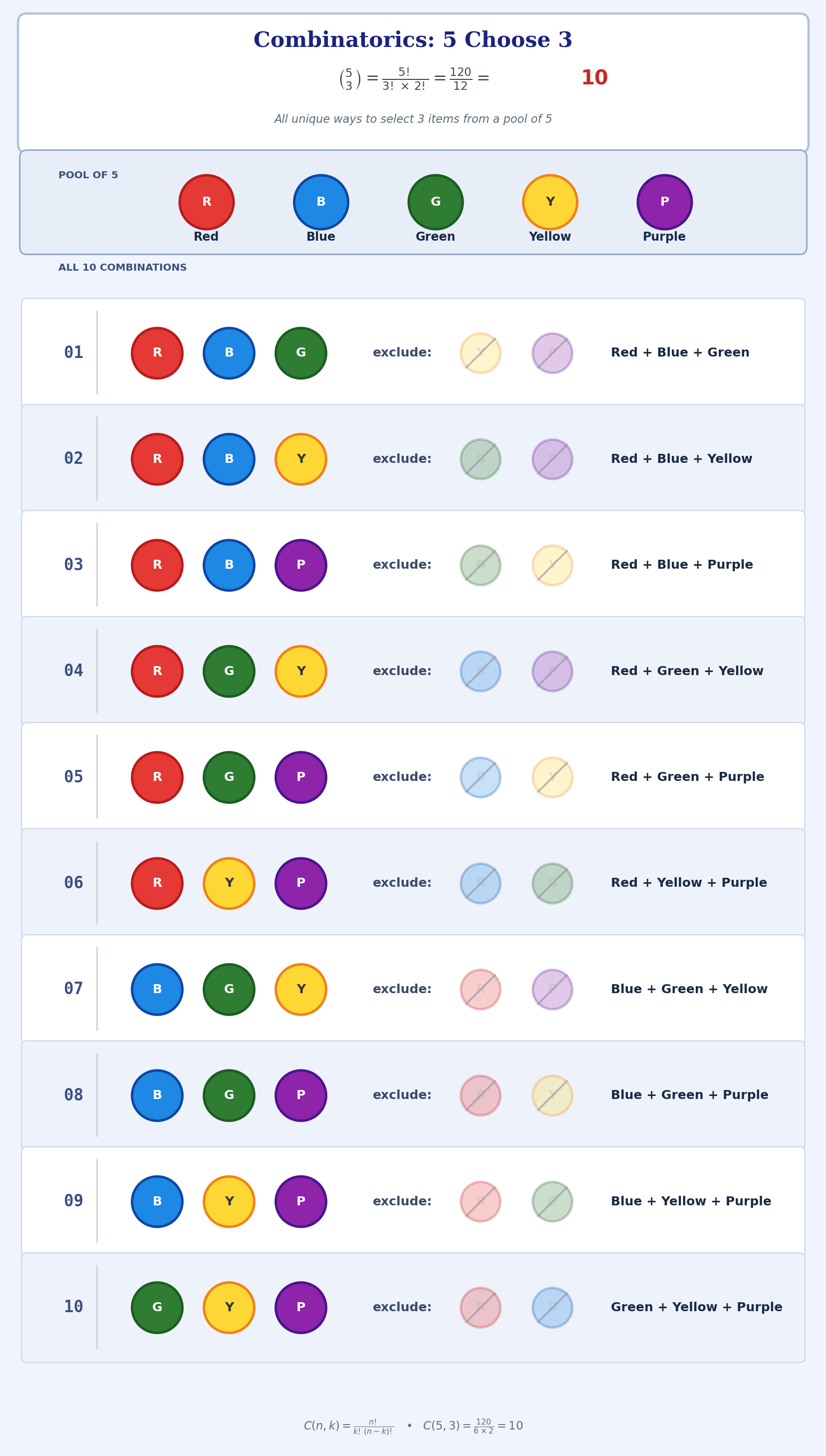
The chart above perfectly illustrates the concept of combinations. We have 5 distinct colors (Red, Blue, Green, Yellow, Purple) and want to select 3 of them. According to our formula:
As shown in the visualization, there are exactly 10 unique ways to select 3 colors from 5:
| Combination | Selected Colors | Excluded Colors |
|---|---|---|
| 01 | Red + Blue + Green | Yellow, Purple |
| 02 | Red + Blue + Yellow | Green, Purple |
| 03 | Red + Blue + Purple | Green, Yellow |
| 04 | Red + Green + Yellow | Blue, Purple |
| 05 | Red + Green + Purple | Blue, Yellow |
| 06 | Red + Yellow + Purple | Blue, Green |
| 07 | Blue + Green + Yellow | Red, Purple |
| 08 | Blue + Green + Purple | Red, Yellow |
| 09 | Blue + Yellow + Purple | Red, Green |
| 10 | Green + Yellow + Purple | Red, Blue |
All 10 combinations of choosing 3 items from 5 distinct items
Key Observations:
- Order doesn't matter: "Red + Blue + Green" is the same as "Green + Red + Blue"
- Each combination appears exactly once in our list
- Every possible group of 3 colors is represented
- The excluded items are simply the complement of the selected items
Permutations vs. Combinations: A Critical Distinction
Understanding when to use permutations versus combinations is crucial:
| Aspect | Permutations | Combinations |
|---|---|---|
| Order matters? | YES | NO |
| Formula | $\frac{n!}{(n-k)!}$ | $\frac{n!}{k!(n-k)!}$ |
| Example | Race medals (1st, 2nd, 3rd) | Committee selection |
| Keywords | Arrange, order, sequence | Select, choose, group |
Comparison of permutations and combinations
Example Comparison: Consider choosing 3 people from 5 people (Alice, Bob, Carol, Dan, Eve).
As a permutation (order matters - say, for president, VP, secretary):
ABC is different from BAC because Alice as president differs from Bob as president.
As a combination (order doesn't matter - say, for a committee):
{Alice, Bob, Carol} is the same as {Bob, Alice, Carol} because it's the same committee.
Practice Problem Set 3
- A committee of 4 people must be selected from 12 candidates. How many different committees are possible?
- From a standard deck of 52 cards, how many 5-card hands can be dealt?
- How many ways can you select 3 books from a shelf of 10 books (where order doesn't matter)?
Solutions:
- $C(12,4) = \frac{12!}{4! \times 8!} = 495$ committees
- $C(52,5) = \frac{52!}{5! \times 47!} = 2{,}598{,}960$ hands
- $C(10,3) = \frac{10!}{3! \times 7!} = 120$ selections
Part 4: Important Combinatorial Identities
Pascal's Identity (Pascal's Rule)
Identity:
This is one of the most important identities in combinatorics[9][10].
Combinatorial Interpretation: The number of ways to choose $k$ objects from $n$ objects equals:
- The number of ways to choose $k$ objects from $n$ objects that include a specific object (we then choose $k-1$ from the remaining $n-1$), PLUS
- The number of ways to choose $k$ objects from $n$ objects that exclude that specific object (we choose $k$ from the remaining $n-1$)
Example: Verify $\binom{5}{3} = \binom{4}{2} + \binom{4}{3}$
Using our earlier calculation: $\binom{5}{3} = 10$
Real-World Application: Consider selecting 3 colors from our 5 colors (Red, Blue, Green, Yellow, Purple). We can partition the 10 combinations into:
- Those that include Red: $\binom{4}{2} = 6$ ways (choose 2 more from the remaining 4)
- Those that exclude Red: $\binom{4}{3} = 4$ ways (choose 3 from the remaining 4)
- Total: $6 + 4 = 10$ combinations
Algebraic Proof: The combinatorial argument above is convincing, but the identity can also be proved directly from the factorial definition $\binom{n}{k} = \dfrac{n!}{k!\,(n-k)!}$. Assume $1 \le k \le n-1$, so every factorial below is defined. Starting from the right-hand side and writing each term explicitly:
Place both fractions over the common denominator $k!\,(n-k)!$. For the first term, multiply numerator and denominator by $k$ (since $k \cdot (k-1)! = k!$); for the second, multiply by $(n-k)$ (since $(n-k) \cdot (n-1-k)! = (n-k)!$):
The bracket simplifies to $k + (n - k) = n$, and $n \cdot (n-1)! = n!$. Therefore:
This is the foundation of Pascal's Triangle, a triangular array where each number is the sum of the two numbers above it.
Pascal's Triangle
Pascal's Triangle is constructed using Pascal's Identity:
Each row $n$ contains the binomial coefficients $\binom{n}{0}, \binom{n}{1}, \binom{n}{2}, \ldots, \binom{n}{n}$.
Properties of Pascal's Triangle:
- Every row begins and ends with 1
- Each interior number is the sum of the two numbers above it
- Row $n$ contains $n+1$ numbers
- The sum of row $n$ equals $2^n$
The Symmetry Property
Identity:
Interpretation: The number of ways to choose $k$ objects from $n$ objects equals the number of ways to choose $n-k$ objects from $n$ objects[8].
This makes intuitive sense: choosing which items to include is equivalent to choosing which items to exclude.
Example: $\binom{5}{3} = \binom{5}{2} = 10$
Choosing 3 colors to include from 5 is the same as choosing 2 colors to exclude from 5.
The Sum Identity
Identity:
Interpretation: The total number of subsets of a set with $n$ elements is $2^n$[11].
Example: For our 5 colors, the total number of possible selections (including selecting none or all) is:
Why $2^n$?: For each of the $n$ objects, we have 2 choices (include it or exclude it), giving us $2 \times 2 \times \cdots \times 2 = 2^n$ total possibilities.
Practice Problem Set 4
- Verify Pascal's Identity for $\binom{6}{4} = \binom{5}{3} + \binom{5}{4}$
- Use the symmetry property to find $\binom{20}{18}$ if you know $\binom{20}{2} = 190$
- Calculate the sum $\binom{4}{0} + \binom{4}{1} + \binom{4}{2} + \binom{4}{3} + \binom{4}{4}$ and verify it equals $2^4$
Solutions:
- $\binom{6}{4} = 15$, $\binom{5}{3} = 10$, $\binom{5}{4} = 5$. Indeed, $15 = 10 + 5$ ✓
- $\binom{20}{18} = \binom{20}{2} = 190$
- $1 + 4 + 6 + 4 + 1 = 16 = 2^4$ ✓
Part 5: The Binomial Theorem
The Theorem
The Binomial Theorem provides a formula for expanding powers of binomials[8]:
Expanded form:
Key Insight: The coefficients in the expansion are precisely the binomial coefficients from row $n$ of Pascal's Triangle!
Examples
Example 1: Expand $(x + y)^3$
Using the binomial theorem with $n=3$:
Notice the coefficients 1, 3, 3, 1 are from row 3 of Pascal's Triangle.
Example 2: Find the coefficient of $x^4y^3$ in the expansion of $(x + y)^7$
The term containing $x^4y^3$ is:
The coefficient is $\binom{7}{3} = 35$.
Applications of the Binomial Theorem
- Probability Theory: Calculating binomial probabilities
- Algebra: Expanding polynomial expressions quickly
- Calculus: Approximating functions using binomial series
- Computer Science: Analyzing algorithm complexity
Practice Problem Set 5
- Expand $(a + b)^4$ using the binomial theorem
- Find the coefficient of $x^5$ in $(x + 2)^7$
- Verify that $(1 + 1)^n = 2^n$ using the binomial theorem (this proves the sum identity!)
Solutions:
- $(a+b)^4 = a^4 + 4a^3b + 6a^2b^2 + 4ab^3 + b^4$
- The term is $\binom{7}{2}x^5 \cdot 2^2 = 21 \cdot 4 \cdot x^5$, so coefficient is $84$
- $(1+1)^n = \sum_{k=0}^{n}\binom{n}{k}1^{n-k}1^k = \sum_{k=0}^{n}\binom{n}{k} = 2^n$ ✓
Part 6: Problem-Solving Strategies
Step-by-Step Approach to Combinatorial Problems
When faced with a combinatorial problem, follow this systematic approach:
- Identify the question type: Are you counting arrangements or selections? Does order matter?
- Check for repetition: Can items be reused? Are some items identical?
- Determine the parameters: What is $n$ (total items) and $k$ (items selected/arranged)?
-
Choose the appropriate formula:
- Order matters, all items: $n!$
- Order matters, $k$ from $n$: $P(n,k) = \frac{n!}{(n-k)!}$
- Order doesn't matter: $C(n,k) = \binom{n}{k} = \frac{n!}{k!(n-k)!}$
- For complex problems: Break into sub-problems and apply addition or multiplication rules
- Verify your answer: Does it make intuitive sense? Check with a simpler case if possible
Common Problem Types
Type 1: Seating Arrangements
Problem: 9 guests attend a dinner at a round table. In how many ways can they be seated?
Solution: For circular arrangements, fix one person's position (to account for rotational symmetry), then arrange the remaining $n-1$ people:
Type 2: Committee Selection with Restrictions
Problem: From 8 men and 7 women, select a committee of 5 people with at least 2 women.
Solution: Use complementary counting or break into cases:
Cases: (2 women, 3 men), (3 women, 2 men), (4 women, 1 man), (5 women, 0 men)
Type 3: Distribution Problems
Problem: How many ways can you distribute 12 identical candies to 4 children?
Solution: This is a "stars and bars" problem. The formula is:
Practice Problem Set 6 (Challenging)
- A password consists of 8 characters, where each character can be a lowercase letter (26 options) or a digit (10 options). How many passwords contain at least one digit?
- How many ways can you arrange the letters in "MATHEMATICS"?
- From a standard deck of 52 cards, how many 5-card hands contain exactly 3 aces?
Solutions:
- Use complementary counting. Total passwords: $36^8$. All-letter passwords: $26^8$. Answer: $36^8 - 26^8 = 2{,}821{,}109{,}907{,}456 - 208{,}827{,}064{,}576 = 2{,}612{,}282{,}842{,}880$
- 11 letters: 2 M's, 2 A's, 2 T's, 1 H, 1 E, 1 I, 1 C, 1 S. Answer: $\frac{11!}{2! \cdot 2! \cdot 2!} = 4{,}989{,}600$
- Choose 3 aces from 4: $\binom{4}{3} = 4$. Choose 2 non-aces from 48: $\binom{48}{2} = 1{,}128$. Answer: $4 \times 1{,}128 = 4{,}512$ hands
Part 7: Real-World Applications
Computer Science and Algorithms
Graph Algorithms: Combinatorics is fundamental to graph theory. The GPS navigation system in your phone uses the A* algorithm, which relies on combinatorial optimization to find the shortest path[12].
Compiler Design: When a compiler allocates registers to variables, it uses graph coloring—a combinatorial problem that determines the minimum number of registers needed[12].
Search Engines: Google's PageRank algorithm uses eigenvalue centrality, a concept rooted in graph theory and combinatorics, to rank web pages[12].
Cryptography and Security
Modern encryption systems rely heavily on combinatorics[13]. The security of many cryptographic protocols depends on the astronomical number of possible key combinations. For example:
- A 256-bit encryption key has $2^{256} \approx 1.16 \times 10^{77}$ possible combinations
- Even checking one trillion combinations per second would take longer than the age of the universe to crack
Network Design and Telecommunications
Combinatorial optimization helps design efficient routing algorithms for the Internet[4]. When data packets travel across the network, combinatorial algorithms determine:
- The most efficient path (minimizing latency)
- Backup routes in case of failure (network redundancy)
- Bandwidth allocation (optimizing data flow)
Computational Biology
DNA sequencing uses combinatorial methods to reconstruct genetic sequences from fragments[13]. With 4 nucleotides (A, C, G, T) and sequences thousands of bases long, the number of possible combinations is staggering. Combinatorial algorithms help:
- Assemble genome sequences from short reads
- Analyze protein folding patterns
- Model evolutionary relationships
Business and Operations Research
Scheduling Problems: A university must schedule courses to classrooms, ensuring no teacher is double-booked and no room is overbooked. This is a combinatorial optimization problem[14].
Resource Allocation: Airlines use combinatorial methods to optimize crew scheduling, minimizing costs while meeting all regulations and constraints.
Inventory Management: Determining optimal stock levels involves combinatorial analysis of demand patterns and supply constraints.
Social Network Analysis
Understanding how people connect in social networks uses graph theory and combinatorics[12]. Applications include:
- Identifying influential individuals (centrality measures)
- Detecting communities within networks
- Predicting information spread (viral marketing)
- Recommending connections (friend suggestions)
Part 8: Advanced Topics Preview
As you continue your combinatorics journey, you'll encounter these fascinating advanced topics:
Generating Functions
Generating functions provide a powerful algebraic approach to solving counting problems. They transform combinatorial problems into algebraic manipulations, often making difficult problems tractable.
Inclusion-Exclusion Principle
This principle provides a systematic way to count objects that satisfy at least one of several properties, accounting for overlaps. The formula is:
Recurrence Relations
Many combinatorial problems have recursive structure. Recurrence relations express a term in a sequence as a function of previous terms. Pascal's Identity is itself a recurrence relation!
Pigeonhole Principle
If you have $n$ pigeonholes and $n+1$ pigeons, at least one pigeonhole must contain more than one pigeon. This simple principle has surprisingly powerful applications in proving existence results.
Ramsey Theory
Ramsey Theory studies conditions under which order must appear in large structures. The famous party problem asks: "What is the minimum number of guests at a party such that at least 3 are mutual friends or at least 3 are mutual strangers?"
Design Theory
Design theory studies arrangements of objects satisfying specific balance and symmetry properties. Applications include experimental design in statistics and error-correcting codes in information theory.
Summary and Key Takeaways
Congratulations on completing this comprehensive introduction to combinatorics! Let's review the essential concepts:
Fundamental Principles
- Addition Principle: For mutually exclusive events, add the number of ways
- Multiplication Principle: For sequential independent events, multiply the number of ways
Counting Methods
| Method | When to Use | Formula |
|---|---|---|
| Factorial | Arrange all $n$ objects | $n!$ |
| Permutation | Arrange $k$ from $n$ objects | $P(n,k) = \frac{n!}{(n-k)!}$ |
| Combination | Select $k$ from $n$ objects | $C(n,k) = \frac{n!}{k!(n-k)!}$ |
Summary of counting formulas
Critical Identities
- Pascal's Identity: $\binom{n}{k} = \binom{n-1}{k-1} + \binom{n-1}{k}$
- Symmetry: $\binom{n}{k} = \binom{n}{n-k}$
- Sum Identity: $\sum_{k=0}^{n}\binom{n}{k} = 2^n$
- Binomial Theorem: $(a+b)^n = \sum_{k=0}^{n}\binom{n}{k}a^{n-k}b^k$
Problem-Solving Strategy
- Identify whether order matters
- Determine if repetition is allowed
- Identify $n$ and $k$ values
- Choose the appropriate formula
- Break complex problems into simpler sub-problems
- Verify your answer makes sense
Applications Across Disciplines
Combinatorics provides essential tools for:
- Computer science (algorithms, data structures)
- Cryptography and security
- Network optimization
- Molecular biology and genetics
- Business operations and scheduling
- Social network analysis
Recommended Next Steps
To deepen your understanding of combinatorics:
- Practice regularly: Work through problem sets and competition problems
- Study graph theory: The natural next step in combinatorics
- Learn probability theory: Combinatorics is foundational to probability
- Explore algorithm design: See combinatorics in action through computational problems
- Read classic texts: Works by Graham, Knuth, Patashnik ("Concrete Mathematics") and Stanley ("Enumerative Combinatorics")
References
- Mastory. (2025). Combinatorics: Everything You Need to Know. Mastory Mathematics Resources. https://mastory.io/math-resources/combinatorics
- GeeksforGeeks. (2024). Real-Life Applications of Combinatorics. https://www.geeksforgeeks.org/maths/real-life-applications-of-combinatorics/
- Morris, J. (2021). Combinatorics: An Upper-Level Introductory Course. University of Lethbridge, Department of Mathematics & Computer Science. https://www.cs.uleth.ca/~morris/Combinatorics/Combinatorics.pdf
- IMPA. (2025). Diana Sasaki uses combinatorics to solve real-world problems. Instituto de Matemática Pura e Aplicada. https://impa.br/notices/diana-sasaki-uses-combinatorics-to-solve-real-world-problems/
- Chie, R. (2017). Combinatorics: How they are important to computer science. Steemit. https://steemit.com/blog/@rihchie.ebb/combinatorics-how-they-are-important-to-computer-science
- TopCoder. (n.d.). Basics of Combinatorics. TopCoder Competitive Programming Tutorials. https://www.topcoder.com/community/competitive-programming/tutorials/basics-of-combinatorics/
- Meyering, R. (2013). Combinatorics 1: Introduction [Video]. YouTube. https://www.youtube.com/watch?v=xayGowEuMbI
- Mastory. (2025). Basic Concepts of Combinatorics: Permutation and Combination. Mastory Mathematics Resources. https://mastory.io/math-resources/combinatorics
- Art of Problem Solving. (2025). Pascal's Identity. AoPS Wiki. https://artofproblemsolving.com/wiki/index.php/Pascal's_Identity
- Wikipedia. (2005). Pascal's rule. https://en.wikipedia.org/wiki/Pascal's_rule
- Ohio University. (n.d.). Pascal's Formula and the Binomial Theorem. Mathematics Course Materials. https://people.ohio.edu/melkonia/math3050/HW/Section9.7.pdf
- Reddit r/math. (2024). What are some applied areas of combinatorics and are they useful? https://www.reddit.com/r/math/comments/1bhgygz/what_are_some_applied_areas_of_combinatorics_and/
- GeeksforGeeks. (2024). Applications of Combinatorics in Network Security and Molecular Biology. https://www.geeksforgeeks.org/maths/real-life-applications-of-combinatorics/
- IMPA. (2025). Combinatorial optimization in scheduling problems. https://impa.br/notices/diana-sasaki-uses-combinatorics-to-solve-real-world-problems/
Review Material for This Page
- Definitions: Counting: Principles, Permutations and Combinations · Pigeonhole, Inclusion-Exclusion and Counted Structures
- Formula quizzes: Counting and Binomial Identities · Pigeonhole, Inclusion-Exclusion and Counted Structures
- The combinatorial proof of the Binomial Theorem is developed in the Binomial Theorem tutorial.