Inverse Trigonometric Functions
From Basic Concepts to Advanced Calculus Applications
1. Basic Level
1.1 Introduction to Inverse Functions
Inverse trigonometric functions allow us to find an angle when given a trigonometric ratio. If \sin(\theta) = x, then the inverse operation is \theta = \arcsin(x) or \theta = \sin^{-1}(x). However, because trigonometric functions are periodic (they repeat values), they are not naturally "one-to-one". To define an inverse function properly, we must restrict the domain of the original function.
Visualizing Inverses: Symmetry across y=x
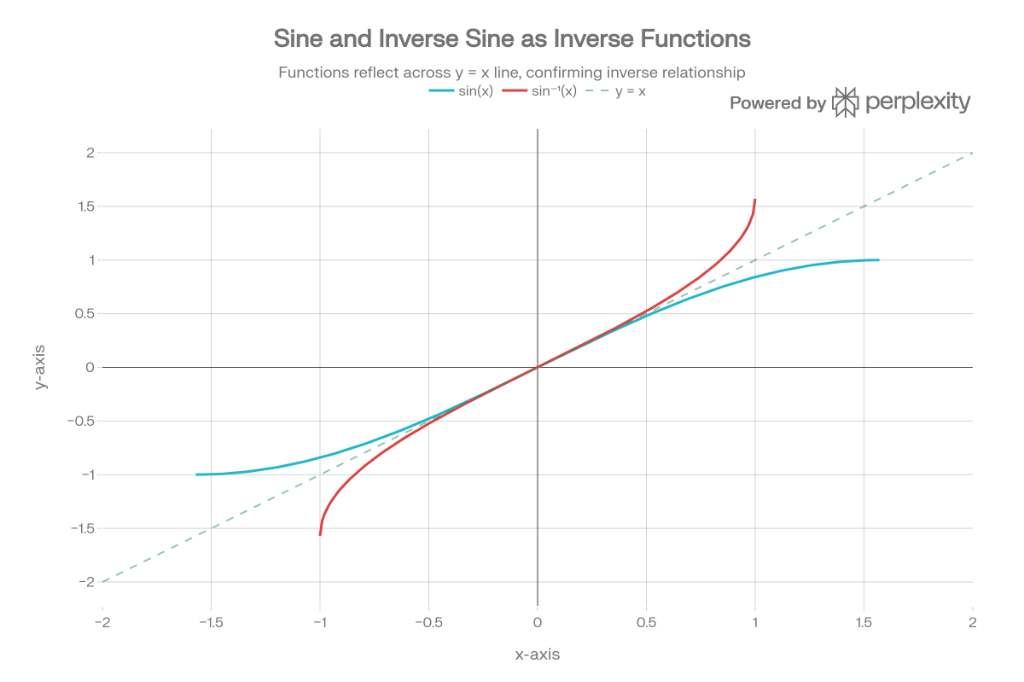
The graph above demonstrates the fundamental geometric relationship between a function and its inverse. The blue curve represents the restricted sine function (y = \sin x), while the red curve represents the inverse sine function (y = \sin^{-1} x).
Notice the dashed line y=x. The red curve is a perfect reflection of the blue curve across this line. This visual symmetry confirms they are inverse functions: the input of one becomes the output of the other. The restricted domain of \sin x ([-\pi/2, \pi/2]) becomes the range of \sin^{-1} x.
Why We Restrict the Domain: The Horizontal Line Test
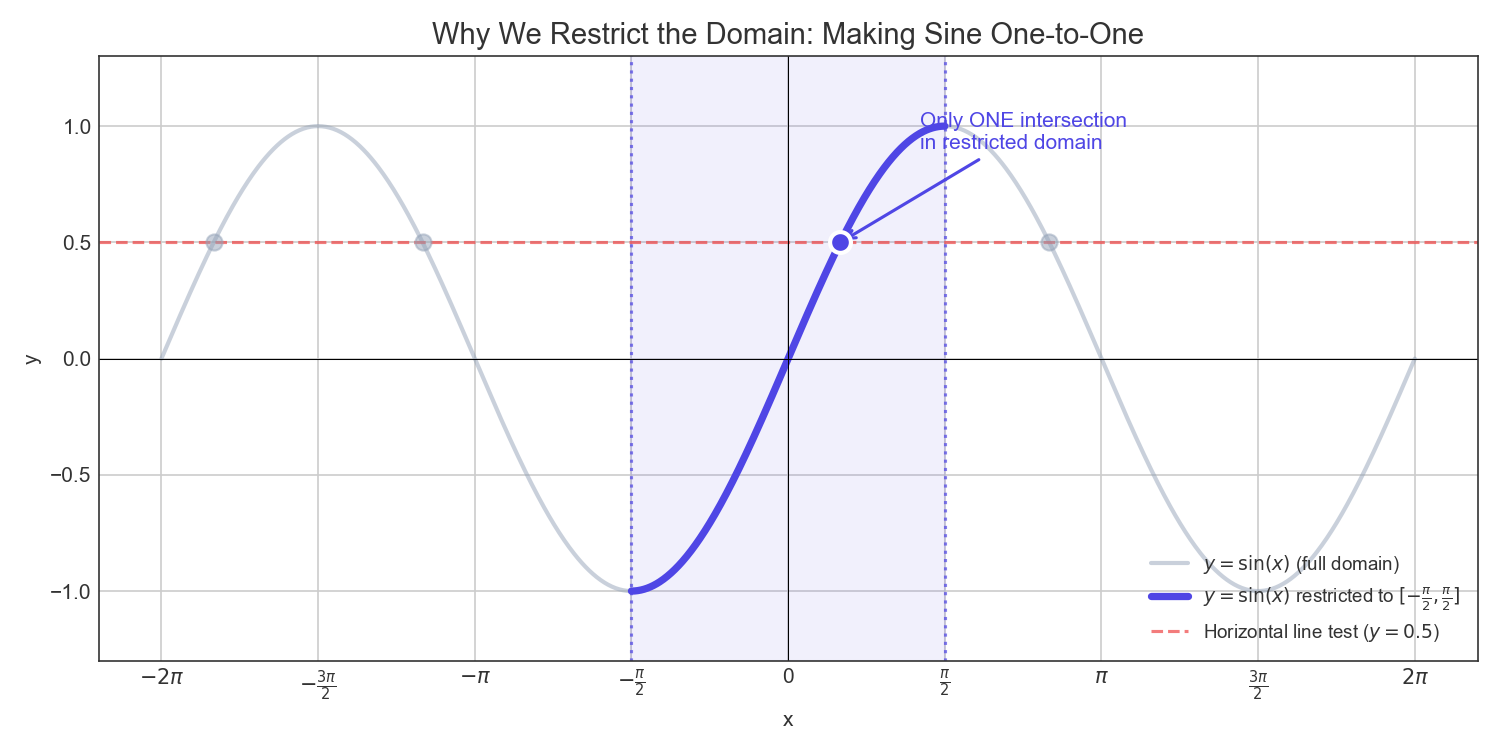
The full sine function (gray curve) fails the horizontal line test: a horizontal line at y = 0.5 crosses the curve infinitely many times. This means there's no unique angle for a given sine value.
By restricting sine to [-\frac{\pi}{2}, \frac{\pi}{2}] (highlighted in blue), the horizontal line crosses only once. Now each output has exactly one input, making the function invertible. This restricted portion becomes the range of \arcsin.
1.2 The Meaning of "Arc"
The prefix "arc" in arcsin and arccos is meaningful because it refers to arc length on the unit circle.
Connection to the Unit Circle
When measuring angles in radians on a unit circle (radius = 1), the arc length is numerically equal to the angle measure. For example, an angle of \frac{\pi}{2} radians corresponds to an arc of length \frac{\pi}{2} along the unit circle.
The term "arcsin(x)" literally means "the arc (or angle) whose sine is x". When you input a value like \arcsin(0.5), you're asking: "What is the arc length on the unit circle that produces a sine value of 0.5?"
Why It Makes Sense
In radians, the relationship is \theta = \frac{\text{arc length}}{r}. On the unit circle where r = 1, we have \theta = \text{arc length}. This means "the arc whose sine is x" and "the angle whose sine is x" are equivalent statements.
Historical Context
The "arc" notation arose in the 1700s, predating modern function notation. It was a straightforward geometric description before the f^{-1} notation for inverse functions was invented. While some have tried to interpret "arc" as simply meaning "inverse," its original geometric meaning is specifically tied to arc length on the circle.
1.3 The Three Main Inverse Trig Functions
Inverse Sine (\arcsin x)
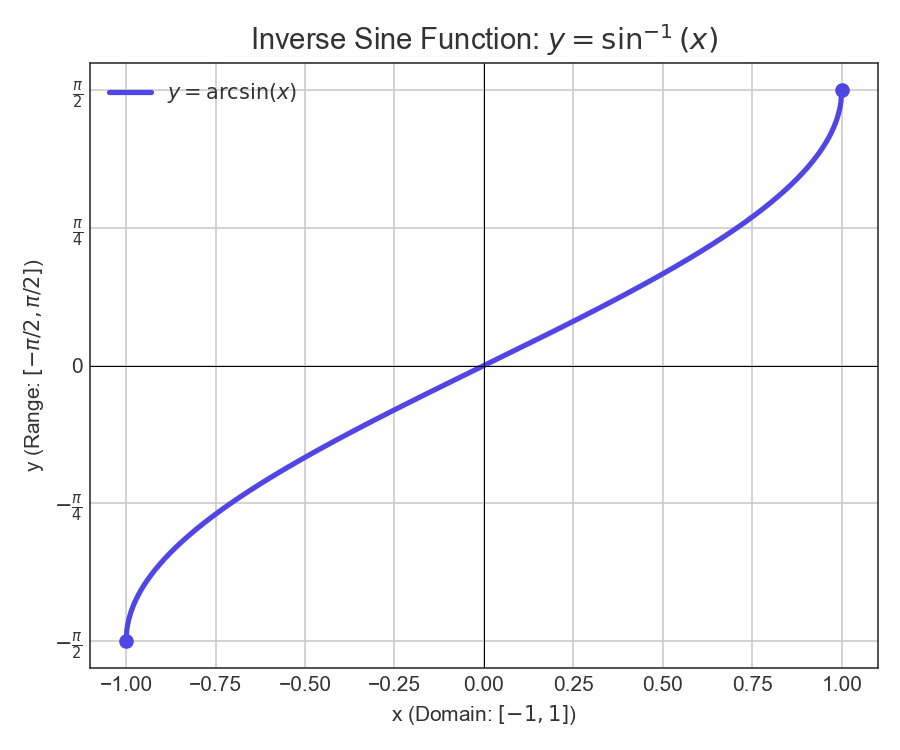
Domain: [-1, 1]
Range: [-\pi/2, \pi/2]
It "undoes" sine. Because \sin(x) oscillates, we restrict the input of sine to [-\pi/2, \pi/2] to make it invertible.
Inverse Cosine (\arccos x)
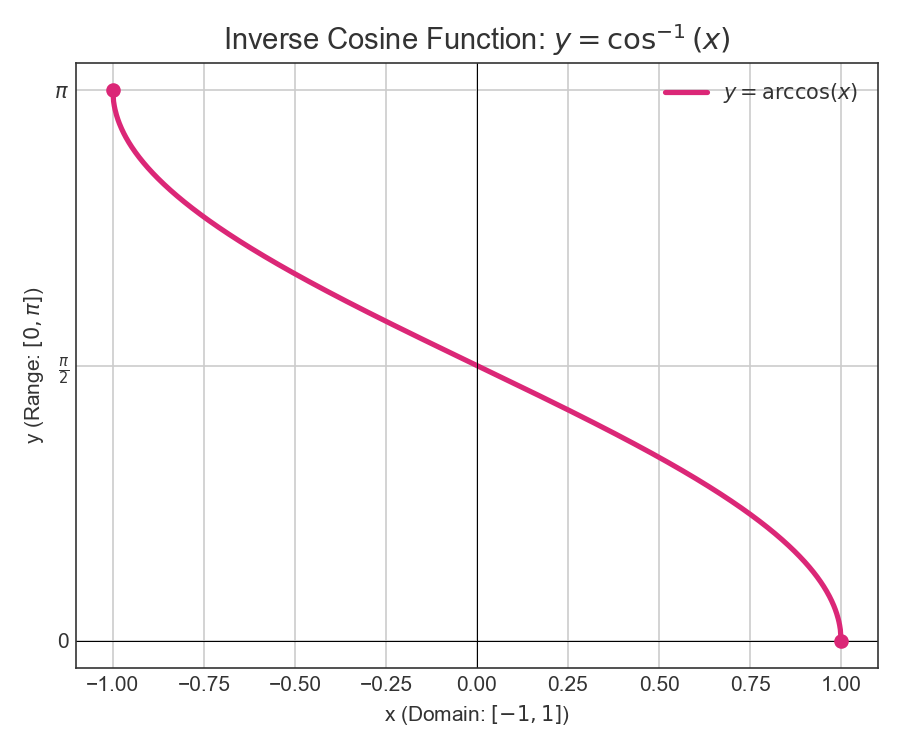
Domain: [-1, 1]
Range: [0, \pi]
It "undoes" cosine. We restrict the input of cosine to [0, \pi]. Note that the outputs are in Quadrants I and II.
Inverse Tangent (\arctan x)
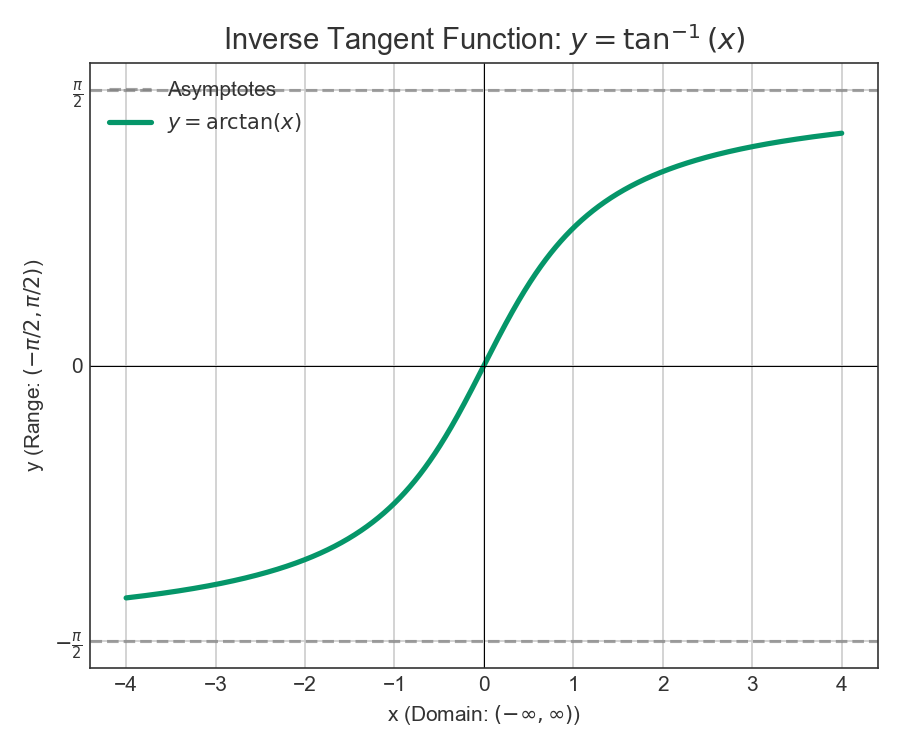
Domain: (-\infty, \infty)
Range: (-\pi/2, \pi/2)
It "undoes" tangent. As x \to \infty, \arctan(x) \to \pi/2. As x \to -\infty, \arctan(x) \to -\pi/2. Horizontal asymptotes exist at y = \pm \pi/2.
1.4 Domain and Range Summary
| Function | Notation | Domain (x) | Range (y or \theta) | Quads |
|---|---|---|---|---|
| Inverse Sine | \arcsin x or \sin^{-1} x | [-1, 1] | [-\frac{\pi}{2}, \frac{\pi}{2}] | I, IV |
| Inverse Cosine | \arccos x or \cos^{-1} x | [-1, 1] | [0, \pi] | I, II |
| Inverse Tangent | \arctan x or \tan^{-1} x | (-\infty, \infty) | (-\frac{\pi}{2}, \frac{\pi}{2}) | I, IV |
1.5 The Reciprocal Inverse Functions
The remaining three inverse trig functions correspond to the reciprocal functions (secant, cosecant, cotangent). They appear less frequently but are important in calculus.
| Function | Notation | Domain | Range |
|---|---|---|---|
| Inverse Secant | \text{arcsec } x or \sec^{-1} x | |x| \geq 1 | [0, \pi], y \neq \frac{\pi}{2} |
| Inverse Cosecant | \text{arccsc } x or \csc^{-1} x | |x| \geq 1 | [-\frac{\pi}{2}, \frac{\pi}{2}], y \neq 0 |
| Inverse Cotangent | \text{arccot } x or \cot^{-1} x | (-\infty, \infty) | (0, \pi) |
- \text{arcsec}(x) = \arccos(\frac{1}{x}) for |x| \geq 1
- \text{arccsc}(x) = \arcsin(\frac{1}{x}) for |x| \geq 1
- \text{arccot}(x) = \arctan(\frac{1}{x}) for x \gt 0 (requires adjustment for x \lt 0)
2. Intermediate Level
2.1 Exact Values and the Unit Circle
We can evaluate inverse trig functions for standard angles without a calculator by reversing the unit circle coordinates.
Example 1: \arcsin(\frac{1}{2})
We ask: "For which angle \theta in [-\pi/2, \pi/2] is \sin(\theta) = 1/2?"
Since \sin(\pi/6) = 1/2, the answer is:
\frac{\pi}{6} (or 30^\circ)
Example 2: \arccos(-\frac{\sqrt{2}}{2})
We ask: "For which angle \theta in [0, \pi] is \cos(\theta) = -\sqrt{2}/2?"
Cosine is negative in Quadrant II. The reference angle is \pi/4. So \pi - \pi/4 = 3\pi/4.
\frac{3\pi}{4} (or 135^\circ)
2.2 Composition of Functions
Composing trig and inverse trig functions requires careful attention to domains and ranges.
Case A: f(f^{-1}(x))
Functions "cancel" out directly if x is in the domain.
- \sin(\arcsin x) = x for x \in [-1, 1]
- \cos(\arccos x) = x for x \in [-1, 1]
- \tan(\arctan x) = x for x \in (-\infty, \infty)
Case B: f^{-1}(f(x))
Functions only "cancel" if x is within the principal range.
\arcsin(\sin(\frac{7\pi}{6})) \neq \frac{7\pi}{6}
Why? Because 7\pi/6 is outside [-\pi/2, \pi/2].
\sin(7\pi/6) = -1/2.
\arcsin(-1/2) = -\pi/6.
Result: -\frac{\pi}{6}
2.3 Using Reference Triangles
To evaluate expressions like \tan(\arccos(x)) (algebraic composition), drawing a right triangle is the most powerful method.
Problem: Simplify \tan(\arccos x)
- Let \theta = \arccos x. This implies \cos \theta = x = \frac{x}{1}.
- Imagine a right triangle where adjacent side is x and hypotenuse is 1.
- By Pythagorean theorem, the opposite side is \sqrt{1^2 - x^2} = \sqrt{1-x^2}.
- We want \tan \theta = \frac{\text{Opposite}}{\text{Adjacent}}.
- \tan(\arccos x) = \frac{\sqrt{1-x^2}}{x}.
More Composition Examples
\sin(\arctan x)
Let \theta = \arctan x. Then \tan \theta = x = \frac{x}{1}.
Opposite = x, Adjacent = 1, so Hypotenuse = \sqrt{1+x^2}.
\sin(\arctan x) = \frac{x}{\sqrt{1+x^2}}
\cos(\arcsin x)
Let \theta = \arcsin x. Then \sin \theta = x = \frac{x}{1}.
Opposite = x, Hypotenuse = 1, so Adjacent = \sqrt{1-x^2}.
\cos(\arcsin x) = \sqrt{1-x^2}
3. Advanced Level
3.1 Fundamental Identities
Convention Note: The second identity assumes \text{arccot} has range (0, \pi), which is the convention used throughout this tutorial. Some texts define arccot with range (-\frac{\pi}{2}, 0) \cup (0, \frac{\pi}{2}), which changes this identity.
3.2 Calculus: Derivatives
The derivatives of inverse trig functions are algebraic functions (involving square roots), not trigonometric ones.
Inverse Sine & Cosine
\[\frac{d}{dx}(\arcsin x) = \frac{1}{\sqrt{1-x^2}}\] \[\frac{d}{dx}(\arccos x) = -\frac{1}{\sqrt{1-x^2}}\]Inverse Tangent
\[\frac{d}{dx}(\arctan x) = \frac{1}{1+x^2}\] \[\frac{d}{dx}(\text{arccot } x) = -\frac{1}{1+x^2}\]Inverse Secant
\[\frac{d}{dx}(\text{arcsec } x) = \frac{1}{|x|\sqrt{x^2-1}}\]Derivation: \frac{d}{dx}(\arcsin x) using Implicit Differentiation
This derivation shows why inverse trig derivatives are algebraic functions:
- Let y = \arcsin(x), which means \sin(y) = x.
- Differentiate both sides with respect to x: $$\cos(y) \cdot \frac{dy}{dx} = 1$$
- Solve for the derivative: $$\frac{dy}{dx} = \frac{1}{\cos(y)}$$
- Use the Pythagorean identity \sin^2(y) + \cos^2(y) = 1 to express \cos(y) in terms of x: $$\cos(y) = \sqrt{1 - \sin^2(y)} = \sqrt{1 - x^2}$$
- We take the positive root because y \in [-\frac{\pi}{2}, \frac{\pi}{2}], where cosine is always non-negative.
$$\boxed{\frac{d}{dx}(\arcsin x) = \frac{1}{\sqrt{1-x^2}}}$$
3.3 Calculus: Integrals
These derivatives lead to standard integration formulas, essential for finding arc lengths and areas.
Application Example: Integration
Evaluate \int \frac{1}{4+x^2} dx.
Here a^2 = 4 \implies a=2. Using the arctangent formula:
\[\int \frac{1}{2^2+x^2} dx = \frac{1}{2}\arctan\left(\frac{x}{2}\right) + C\]4. Common Mistakes to Avoid
Mistake 1: Confusing inverse with reciprocal
\sin^{-1}(x) \neq \frac{1}{\sin(x)}
The notation \sin^{-1}(x) means "the angle whose sine is x" (inverse function), NOT "one divided by sine of x" (reciprocal). The reciprocal of sine is \csc(x). To avoid confusion, use \arcsin(x) notation.
Mistake 2: Assuming compositions always cancel
\arcsin(\sin(2\pi)) \neq 2\pi
\arcsin(\sin(\theta)) = \theta only when \theta \in [-\frac{\pi}{2}, \frac{\pi}{2}]. For values outside this range, you must find the equivalent angle in the principal range. Here: \sin(2\pi) = 0, so \arcsin(0) = 0, not 2\pi.
Mistake 3: Forgetting domain restrictions
\arcsin(2) is undefined
The domain of \arcsin and \arccos is [-1, 1] only. No real angle has a sine or cosine greater than 1 or less than -1. If you get such a value in a calculation, check your work for errors.
Mistake 4: Wrong quadrant for arccos
\arccos(-\frac{1}{2}) \neq -\frac{\pi}{3}
Unlike \arcsin and \arctan, the function \arccos never returns negative angles. Its range is [0, \pi] (Quadrants I and II only). The correct answer is \arccos(-\frac{1}{2}) = \frac{2\pi}{3}, which is in Quadrant II.
5. Practice Problems
Basic Level
1. Evaluate \arctan(1)
Show Answer
\arctan(1) = \frac{\pi}{4} because \tan(\frac{\pi}{4}) = 1.
2. Evaluate \arccos(0)
Show Answer
\arccos(0) = \frac{\pi}{2} because \cos(\frac{\pi}{2}) = 0 and \frac{\pi}{2} \in [0, \pi].
3. Evaluate \arcsin(-\frac{\sqrt{3}}{2})
Show Answer
\arcsin(-\frac{\sqrt{3}}{2}) = -\frac{\pi}{3} because \sin(-\frac{\pi}{3}) = -\frac{\sqrt{3}}{2} and -\frac{\pi}{3} \in [-\frac{\pi}{2}, \frac{\pi}{2}].
Intermediate Level
4. Simplify \cos(\arctan(\frac{3}{4}))
Show Answer
Let \theta = \arctan(\frac{3}{4}). Then \tan\theta = \frac{3}{4}.
Draw a right triangle: opposite = 3, adjacent = 4, hypotenuse = \sqrt{9+16} = 5.
Therefore, \cos(\arctan(\frac{3}{4})) = \frac{4}{5}.
5. Evaluate \arcsin(\sin(\frac{5\pi}{6}))
Show Answer
First, \sin(\frac{5\pi}{6}) = \frac{1}{2} (reference angle \frac{\pi}{6} in Q II).
Then \arcsin(\frac{1}{2}) = \frac{\pi}{6}.
Answer: \frac{\pi}{6} (not \frac{5\pi}{6}, since that's outside the principal range).
Advanced Level
6. Evaluate \int \frac{1}{9+x^2} \, dx
Show Answer
This matches the form \int \frac{1}{a^2+x^2} dx = \frac{1}{a}\arctan(\frac{x}{a}) + C with a = 3.
$$\int \frac{1}{9+x^2} dx = \frac{1}{3}\arctan\left(\frac{x}{3}\right) + C$$
7. Find \frac{d}{dx}\left[\arctan(3x)\right]
Show Answer
Using the chain rule with \frac{d}{dx}(\arctan u) = \frac{1}{1+u^2} \cdot \frac{du}{dx}:
$$\frac{d}{dx}[\arctan(3x)] = \frac{1}{1+(3x)^2} \cdot 3 = \frac{3}{1+9x^2}$$
6. Real-World Applications
Inverse trigonometric functions appear throughout science and engineering whenever we need to find an angle from a ratio.
Navigation & Surveying
Finding bearing angles between two points uses \arctan. Given the difference in coordinates (\Delta x, \Delta y), the bearing angle is:
$$\theta = \arctan\left(\frac{\Delta y}{\Delta x}\right)$$
GPS systems and mapping software use this constantly.
Physics: Projectile Motion
To launch a projectile to hit a target at distance R with initial speed v_0, the launch angle is:
\theta = \frac{1}{2}\arcsin\left(\frac{gR}{v_0^2}\right)
Where g is gravitational acceleration.
Electrical Engineering
In AC circuits, the phase angle between voltage and current is:
\phi = \arctan\left(\frac{X_L - X_C}{R}\right)
Where X_L is inductive reactance, X_C is capacitive reactance, and R is resistance.
Computer Graphics
Converting between Cartesian and polar coordinates, rotating objects, and calculating camera angles all require inverse trig functions.
\theta = \text{atan2}(y, x)
The atan2 function handles all quadrants correctly.
asin, acos, atan (or Math.asin, etc.).
The function atan2(y, x) is a two-argument variant that correctly handles all
four quadrants.
Summary
- Domain Restrictions: Inverse trig functions exist because we restrict original functions to pass the horizontal line test (e.g., Sine to [-\pi/2, \pi/2]).
- Ranges: \arcsin and \arctan output to [-\pi/2, \pi/2] (Quadrants I and IV). \arccos outputs to [0, \pi] (Quadrants I and II).
- All Six Functions: The three main functions (\arcsin, \arccos, \arctan) plus three reciprocal inverses (\text{arcsec}, \text{arccsc}, \text{arccot}).
- Triangle Method: Use right triangles to simplify compositions like \sin(\arctan x) algebraically.
- Calculus: Derivatives are algebraic: \frac{d}{dx}\arcsin x = \frac{1}{\sqrt{1-x^2}}, \frac{d}{dx}\arctan x = \frac{1}{1+x^2}.
- Common Pitfalls: Don't confuse \sin^{-1}(x) with 1/\sin(x); compositions don't always "cancel."
Review Material for This Page
- Definitions: Angles, the Unit Circle and the Six Functions · Trigonometry Identity Definitions
- Formula quizzes: Inverse Functions